
— tonnes of global SAF produced this year · 61 Mt forecast demand by 2035
Sustainable fuel
for aviation and shipping.
From the field, not the well.
We convert low-cost agricultural and forestry residues into drop-in biocrude — refined into the same jet, marine, and chemical fuels the world already runs on, without modification to engines or infrastructure.
¹ Plant-level returns from the canonical financial model (300k tpa multi-product configuration). See Investors for full assumptions and risk disclosures.
A market in shortfall. A waste stream of unmatched scale. A technology that fits.
Global sustainable aviation fuel production is around two million tonnes annually — less than 1% of demand. Forecast SAF demand reaches 60+ million tonnes per annum by 2035. Marine fuel decarbonisation adds further pull. The world's airlines and shipping fleets need fuel that is genuinely drop-in, certified, and available at scale.
Agricultural and forestry residues are the largest under-exploited bioenergy resource on Earth, with billions of tonnes generated globally each year. Cat-HTR™ hydrothermal liquefaction converts these residues — at moisture levels and feedstock variability that defeat competing routes — into a stable, fungible biocrude that drops into existing refining infrastructure.
Hydrothermal liquefaction at commercial scale.
Cat-HTR™ is the result of two decades of development by Licella Holdings. It uses supercritical water as a reactive solvent to convert wet biomass directly into a stable biocrude — without drying, with feedstock flexibility unmatched in the field, refinable in existing infrastructure. ABGL operates Cat-HTR™ in India under licence from Licella.
Read the technology briefContinuous fast-batch processing — fast and predictable.
Wet feedstocks accepted directly — no drying step required.
Significantly above industry-average HTL conversion efficiency.
reactors
Modular reactor trains scale plant capacity to commercial levels.
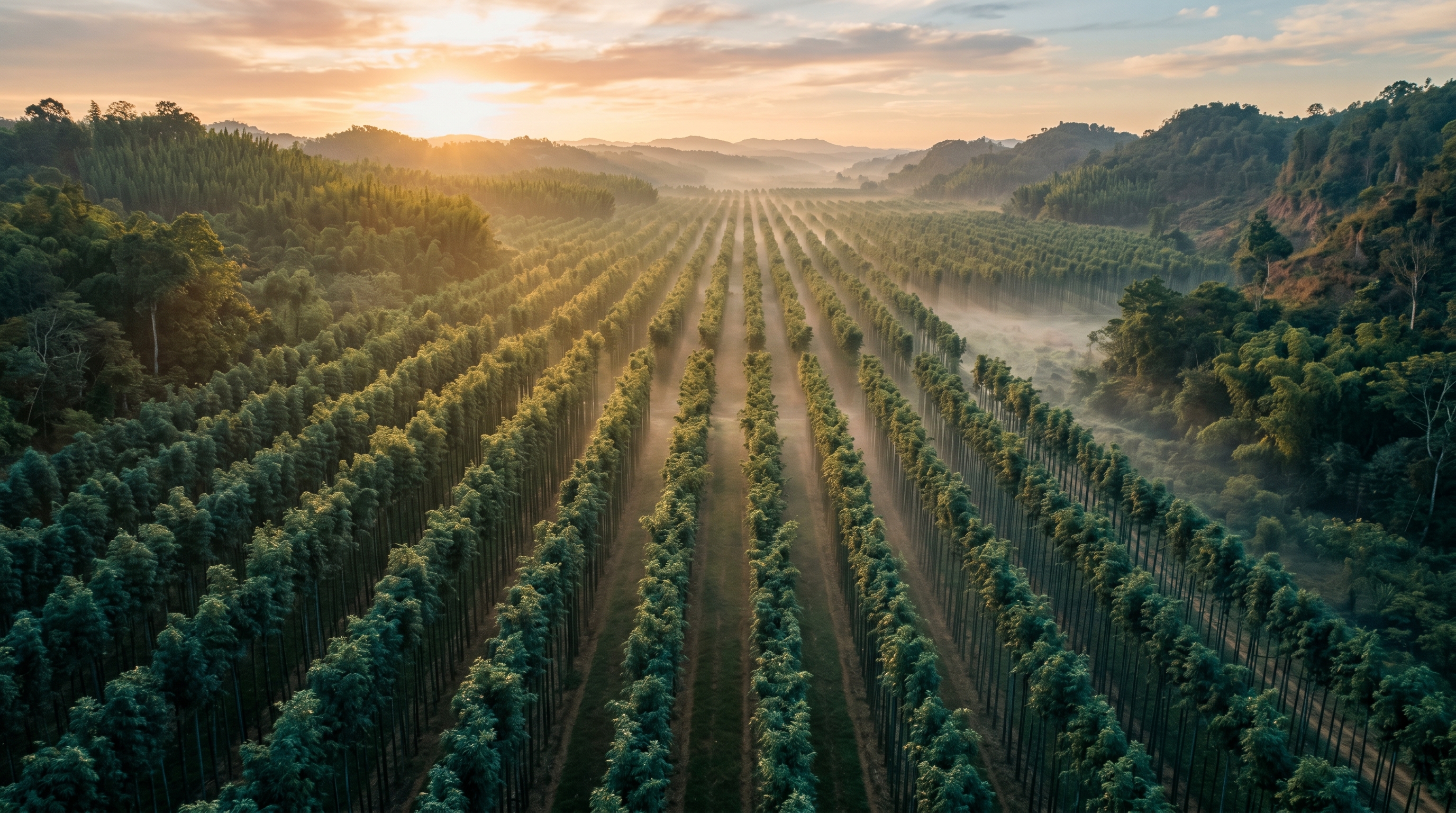
Cultivated bamboo — fast-growing, contracted at scale, and uniquely suited to Cat-HTR™ hydrothermal liquefaction.
FIG 2.1 · CULTIVATED BAMBOO PLANTATION
Building plants where the feedstock is most abundant.
ABGL's first generation of plants is being developed in partnership with state governments under established Public-Private Partnership frameworks, drawing on capital grants, tax incentives, and SGST reimbursement.
First-generation deployment
Active project pipeline of $3.12 billion across multiple state-level Public-Private Partnerships, with MoU and PPP agreements in place.
Multi-region expansion
Replicating the deployment model in additional regions where the agricultural waste resource is abundant and policy environments favourable.
Global supply
Export-oriented biocrude and refined product flows into the global SAF and SMF markets — including the EU, US, Japan, and Korea blending mandates.
Operators with scale-up history.
ABGL is led by founders with decades of experience building industrial businesses, taking companies public, and operating across UK, Australian, and Asian markets — supported by a senior corporate finance team and an experienced advisory board.
Meet the teamIndustrialist and serial founder with over three decades of cross-border industrial venture creation and direct state-government relationships across India's Northeast.
Former CFO of Aker Offshore Wind and former Chairman of Freja Offshore. Over a decade in Nordic renewables finance.
Operational lead with deep experience scaling industrial and project-finance businesses.
Senior strategic counsel chairing ABGL's advisory board, with extensive Indian government and policy experience.
A pre-IPO position in a sector that cannot be built fast enough.
ABGL is preparing its admission to the LSE Main Market under the new ESCC category. Limited pre-IPO allocations are available to qualified investors via our regulated channels.